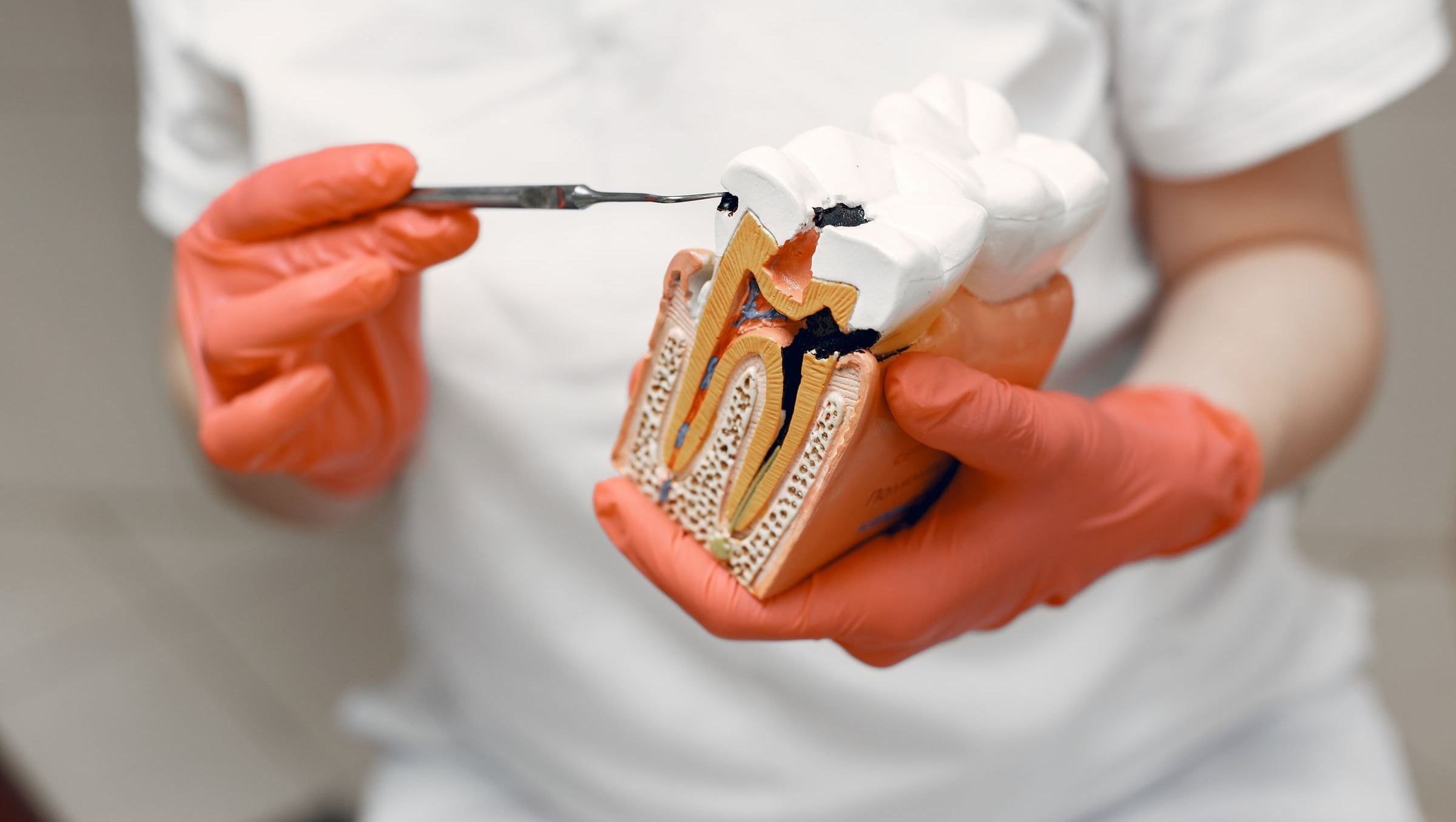
Hearing that the nerve of a tooth is inflamed usually comes with two words attached: root canal. For the right tooth there is another option, called vital pulp therapy, that keeps part of the pulp alive.
What vital pulp therapy is
The pulp, often called the nerve, is the soft tissue of nerves and blood vessels inside the tooth. The American Association of Endodontists (AAE) groups several procedures under vital pulp therapy:
- Pulp capping, where a protective material is placed over the pulp, either over a thin layer of remaining tooth or directly on an exposed spot.
- Partial pulpotomy, where a small amount of inflamed pulp near the exposure is removed.
- Full pulpotomy, where the pulp in the crown of the tooth is removed and the pulp in the roots is kept.
The pulp is then covered with a protective material. Calcium silicate materials, the family that includes MTA and newer bioceramics, have the best record. The AAE reports success of 85 to 100 percent at one to two years when they are used in permanent teeth with irreversible pulpitis. Calcium hydroxide, glass ionomer and resin-based materials did less well, with success ranging from 43 to 92 percent. A 2026 European guideline, developed with the European Society of Endodontology, recommends calcium silicate materials over calcium hydroxide.
Adults with tooth pain can be candidates
The AAE’s 2021 position statement says there may now be options other than a root canal for fully formed adult teeth, including teeth once thought too inflamed to recover. A diagnosis of irreversible pulpitis is not automatically a reason to remove the whole pulp, and even teeth with symptoms may qualify once the pulp is examined directly. The European guideline calls pulpotomy an acceptable alternative to removing the whole pulp when there are signs of irreversible pulpitis.
A 2025 review of 34 studies found that age did not affect the results of partial or full pulpotomy. Direct pulp capping was less successful in patients over 40, probably, the authors suggest, because the pulp is harder to inspect directly.
Who is a good candidate, and who is not
- The pulp has to be alive. The AAE recommends looking at the pulp directly, with a surgical microscope, which can reveal a pulp that has already died. Then vital pulp therapy is not an option.
- The bleeding has to settle. Bleeding must be controlled so the dentist can judge how inflamed the pulp is. How much pulp is kept depends on that and on how the tissue looks.
- The tooth has to be repairable and able to be kept clean and dry during treatment. These were the entry requirements in the PROVE study.
Some signs lower the odds. In PROVE, early failure, almost all of it after pulpotomy, was linked to a tooth that was tender when tapped before treatment, molars, pain that disturbed sleep, and bleeding that was slow to stop once the pulp was exposed. A 2019 meta-analysis of partial pulpotomy in back teeth found that the condition of the pulp before treatment was the only factor it examined that made a significant difference: studies that included teeth diagnosed with irreversible pulpitis had lower success.
The final decision is made during the visit. If the tissue does not look healthy or the bleeding will not settle, a root canal may be the better choice.
What the visit involves
- The tooth is numbed and opened, and the pulp is examined, ideally under a surgical microscope.
- If needed, inflamed pulp is removed, a little or all of the part in the crown, depending on how it looks.
- The bleeding is controlled, typically by bathing the pulp in a disinfecting solution, sodium hypochlorite, for 5 to 10 minutes, although times vary.
- A calcium silicate material is placed over the remaining pulp.
- The tooth is sealed right away with a long-term filling, which the AAE links with high success.
How well it works
- A 2019 systematic review of 8 articles on pulpotomy in fully formed adult teeth with decay and symptoms of irreversible pulpitis found average success of 97.4 percent on clinical exam and 95.4 percent on x-rays at 12 months, falling to about 94 percent and 88 percent at 36 months.
- The 2019 meta-analysis of partial pulpotomy, which pooled 11 studies of back teeth with decay that reached the pulp, found success of 98 percent at six months, 96 percent at one year and 92 percent at two years.
A caveat: the first review notes its studies varied widely and carried a high risk of bias, and the European guideline rates the certainty of the evidence as very low to moderate.
How it compares with a root canal
The 2019 review of 8 articles found one trial that compared the two directly. Pulpotomy had comparable success to root canal treatment at one, two and five years.
The PROVE study, published in 2026, pooled randomized trials of full pulpotomy and root canal treatment from eight countries, with 385 patients analyzed, all with painful irreversible pulpitis. Both treatments relieved pain within a week, but root canal treatment relieved it somewhat more: at day 7, 19.7 percent of pulpotomy patients were still taking pain relievers, compared with 9.4 percent after a root canal. Early failure, meaning more treatment was needed within four weeks, was low in both groups but more common after pulpotomy, 5.2 percent versus 0.5 percent.
The honest summary: in a well-chosen tooth, vital pulp therapy is a less invasive option with high reported success, and a small number of these teeth will still need more treatment.
Follow-up
A 2019 review of partial pulpotomy considered six months a reasonable time to judge whether treatment is working, and said further exams and x-rays after that are essential. Expect follow-up visits over the months after treatment to confirm the tooth is healing.
How we approach vital pulp therapy
We offer vital pulp therapy, MTA repair and pulp regeneration as well as root canal treatment. Dr. El-Refai works with a surgical operating microscope, the tool the AAE recommends for examining the pulp, and when the pulp can be kept, she places a bioactive material such as MTA over the healthy pulp to encourage healing. Every tooth leaves with a permanent filling, never a temporary one.
We are honest about the odds. Before treatment, we explain the risks and the chances of success, so you can decide with confidence. Learn more about regenerative endodontics and root canal treatment, or contact us to ask whether your tooth might be a candidate.